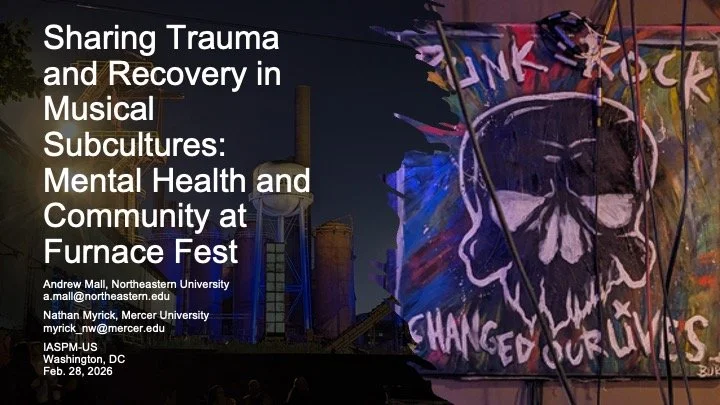
Sharing Trauma and Recovery in Musical Subcultures: Mental Health and Community at Furnace Fest
International Association for the Study of Popular Music, U.S. Branch
IASPM-US, Washington, D.C., February 28, 2026.
Co-authored with Nathan Myrick.
Abstract
Furnace Fest (FF) is a punk, hardcore, emo, and metal (PHEM) music festival in Birmingham, AL that initially ran in 2000–03. Following a hiatus, FF returned in 2021 as an annual event marketed to fans in their 30s and 40s. We have been conducting iterative, collaborative, mixed-methods ethnographic fieldwork within the Furnace Fest Community (FFC) throughout FF’s ongoing “rebirth” cycle.
Despite initial objectives of understanding nostalgia in FF’s branding, marketing, and attraction to long-time PHEM fans, we quickly discovered that nostalgia, while present, was not the only aspect of FF’s success. Additionally, we found an aging subcultural community that welcomes and empowers members to share their trauma and offer recovery support. This reflects conceptions (both emic and etic) of PHEM participants as being “fucked up” and finding refuge in the scene, to quote musician Norman Bannon (2023). Healing from trauma is a common experience for FFC members, and acts of sharing trauma both benefit from and strengthen bonds to and within the commIASPM-USunity. For many long-term participants, this music and scene have become an important aspect of their mental and emotional well-being.
Drawing from 4+ years of fieldwork, we argue in this presentation that these data reveal a potent intersection of community formation amidst conflicting strategies (and varying resources) for care and recovery. Complicating PHEM, DIY, and subculture ethics (Mullaney 2007; Mall 2015, 2020; Bolt 2016; Frese 2017; Abraham 2020; etc.), studying the FFC offers insight to (1) trauma scholarship by examining affective narrative recovery strategies through musical participation, and (2) popular music scholars by demonstrating how communities and scenes form around sharing experiences of and ideas about trauma and recovery.